
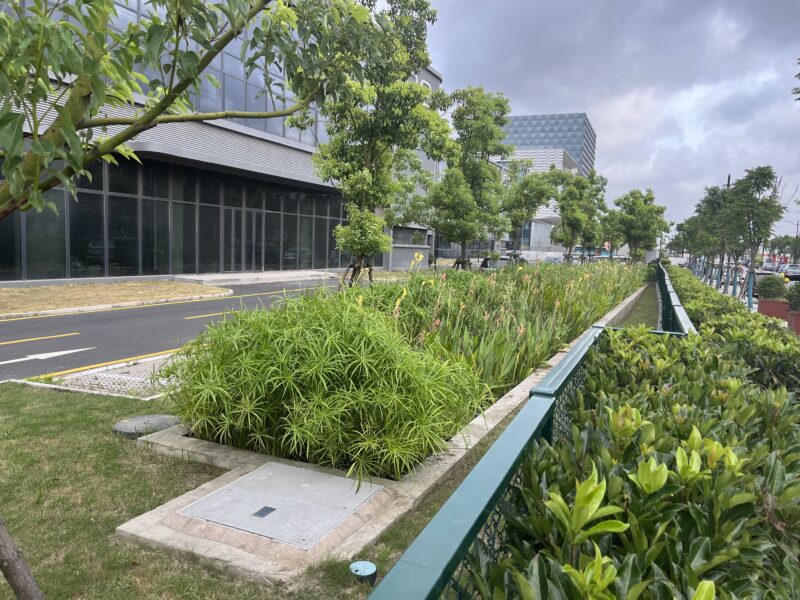
Creating a City that Breathes: How High-Strength Underground Storage Tanks Turn Rainwater from a Hazard into a Resource
In recent years, news reports of “urban sea viewing” during heavy rains have become all too common. After a downpour, streets become rivers, garages flood, traffic grinds to a halt—causing significant economic losses and safety hazards that plague city managers. Simultaneously, many cities face the paradox of water scarcity.
The “Sponge City” concept emerged in response. Its core principle is to enable cities to function like sponges: absorbing, storing, infiltrating, and purifying rainwater at the source during rainfall, then releasing and utilizing the stored water when needed. However, the reality often falls short of the ideal. Traditional sponge facilities like permeable pavers and sunken green spaces often struggle against extreme rainfall and limited urban underground space.
Today, from the perspective of an innovative product, let’s explore a more efficient and robust solution: prefabricated, modular storage tanks. Using our company, Shanghai Ledo Industrial Co., Ltd.‘s landmark product, the Hydro-Carbon Gallery-Type Module, as an example, we’ll examine how modern technology provides “hardcore” strength to the Sponge City initiative.
1. Where Do Traditional Solutions Fall Short?
The Sponge City approach encompasses six functions: infiltration, detention, retention, purification, utilization, and drainage. Traditional methods often focus mainly on surface “infiltration” and “detention,” but face several core challenges:
-
Low Load-Bearing Capacity: Cannot be applied to high-load areas like parking lots, fire lanes, and municipal roads—precisely the critical zones that need rapid drainage.
-
Inefficient Use of Underground Space: Traditional reinforced concrete tanks have long construction cycles, large footprints, and are difficult to maintain once built. Issues like siltation can significantly reduce storage capacity over time, diminishing their functionality.
-
Lack of Flexibility: Difficult to adapt to irregular land shapes and complex pipeline networks.
2. The Key to a Solution: Modular, High-Strength, Self-Cleaning Tanks
Solving these problems requires innovation in underground storage. An ideal underground tank should possess the following traits:
-
Durability: Capable of withstanding heavy vehicle loads, making it suitable for unrestricted application.
-
Rapid Installation: Modular assembly, like building blocks, significantly shortens construction time and minimizes disruption.
-
Easy Maintenance: Must solve the long-term challenge of cleaning, ensuring storage capacity remains like new for decades.
-
Adaptability: Can be configured flexibly according to project needs, handling various complex terrains.
This was the original intention and core breakthrough behind Shanghai Ledo Industrial‘s development of the Hydro-Carbon Gallery-Type Module.
3. In-Depth Analysis: Technological Innovations of the Hydro-Carbon Gallery-Type Module
The name sounds technical, but the concept is straightforward. It is essentially a series of high-strength modules prefabricated using a carbonization process—think of them as super-strong “underground rainwater Lego blocks.”
-
A Material Revolution: The Foundation of Strength
It’s not ordinary concrete. It uses a special formulation based on calcium silicate and calcium aluminate, undergoing a mineralization-like process to form a sturdy hydrocarbon structure. This material is not only high-strength (exceeding the HS-20 loading standard, easily handling fire trucks) but also utilizes naturally acid-resistant aggregates for corrosion resistance and long life. We even “tailor” the formula based on local soil and environmental conditions, a rarity in the industry.
-
Dual-Mode Cleaning Technology: Ending the Maintenance Nightmare
This is, in my view, the most noteworthy innovation. Traditional tank cleaning is a major hurdle. The Hydro-Carbon Gallery-Type Module incorporates both intelligent robotic cleaning and gated flushing systems. This allows maintenance personnel to perform automated, comprehensive cleaning of the underground tank—like a “colonoscopy”—ensuring the storage space remains permanently usable. This addresses the critical weakness of “emphasizing construction but neglecting maintenance” in sponge city facilities.
-
Ultimate Flexibility: The True Spirit of “Modular”
The product height is flexible, ranging from 800mm to 3000mm. It supports individual configuration, multi-layer stacking, and random placement. Whether for the narrow edges of a school playground or beneath a wide airport runway, it can be perfectly embedded, maximizing the use of every inch of valuable underground space, truly achieving “fully buried use without affecting original land use.”
4. What Practical Value Does It Deliver?
-
For City Managers: Effectively implements peak flow control (reducing peak flow to prevent waterlogging) and total runoff volume control. Simultaneously, collected and purified rainwater can be reused for irrigation and road cleaning, achieving rainwater resource utilization.
-
For Developers and Property Owners: Rapid installation saves time and labor costs. The high load-bearing capacity turns parking lots and community roads into massive hidden reservoirs, increasing land value. The long lifespan and low-maintenance design reduce long-term operational costs.
-
For Citizens: Living in cities with less flooding, more greenery, and a more harmonious water environment enhances the sense of well-being and security.
5. Conclusion: Moving Towards a Future of Harmony Between People and Water
“Sponge City” is not a distant concept; it requires solid technologies and products for support. The mission of Shanghai Ledo Industrial Co., Ltd. is to be a “Creator of Harmony Between People and Water.” The Hydro-Carbon Gallery-Type Module is more than just a product; it embodies our thinking and solution for future urban water environment management.
It demonstrates that through technological empowerment, we can coexist with nature more intelligently and efficiently, transforming rainwater from a “burden” into a “resource,” and genuinely building an urban water ecological environment where people and nature exist in harmony.