
Concrete, FRP, or PP modules — which rainwater storage tank is right for you? This article compares construction time, cost, lifespan, and maintenance to help you decide.
Over the years, I’ve had many people ask me the same question: how to choose a rainwater storage tank? Between concrete tanks, FRP tanks, and PP modular tanks, which one should I pick? In this rainwater storage tank comparison, I’ll break down the pros and cons of all three options.
Honestly, there’s no one-size-fits-all answer. Every project has different site conditions, budgets, and timelines. But if you ask me to give a recommendation based on real-world experience, my preference is actually quite clear.
Let me walk you through each option.
Concrete Rainwater Storage Tanks: Proven, but Not Always Cost-Effective
Concrete tanks are the most traditional solution. They’re technically mature and suitable for large residential complexes and public buildings. In theory, they can last as long as the building itself.
But the drawbacks are hard to ignore.
Construction is a headache. Formwork, rebar tying, pouring, curing — the list goes on. And weather plays a big role. High temperatures require constant watering during curing; cold temperatures risk cracking. A single tank can take weeks or even a month to complete. Plus, the noise and dust on site are significant, especially in built-up areas where complaints are almost guaranteed.
Long-term issues are common. The rough inner surface tends to accumulate sediment and algae, shortening water quality retention periods. Worse, once cracks appear, repairs are difficult and expensive. Settlement is another concern — concrete is heavy, and poor foundation treatment can lead to uneven settlement and structural damage.
One thing many people overlook: concrete tanks are a one-time investment. When the building is demolished or renovated, the tank has to be broken up and disposed of as construction waste. No recycling possible.
That said, concrete still has its place. For projects that require basement installation or have strict fire resistance requirements, it remains a solid choice.
FRP Rainwater Tanks: Quick Installation, but Limited
FRP (fiberglass reinforced plastic) tanks solve one of concrete’s biggest problems: long construction time. They arrive on site as finished products and can be installed in a day with proper crane coordination.
But they come with their own limitations.
Capacity is restricted. A single FRP tank typically maxes out at around 100 cubic meters. For larger volumes — say 300 or 500 cubic meters — you need multiple tanks connected in series or parallel. That means more footprint, more piping complexity, and often higher overall cost.
Structural strength is a concern. FRP has low elastic modulus, meaning it lacks rigidity. When fully filled, water pressure helps support external loads. But when partially filled or empty, the top is vulnerable to cracking under backfill pressure. We’ve seen cases where improper backfill caused the tank top to collapse. That’s why installation requires filling water simultaneously with backfilling — a delicate operation.
Transportation can be tricky. Large FRP tanks are oversized cargo, with high shipping costs. Some remote sites are simply inaccessible.
Like concrete, FRP tanks are single-use and difficult to recycle. They also degrade under UV exposure, though this is less of an issue for buried installations.
PP Modular Rainwater Tanks: Flexible, Efficient, Increasingly Popular
PP modular tanks have gained rapid traction in recent years. I’ll admit, when I first encountered them, I had doubts: plastic modules buried underground — can they really handle the load?
After reviewing test data and visiting actual projects, those concerns faded.
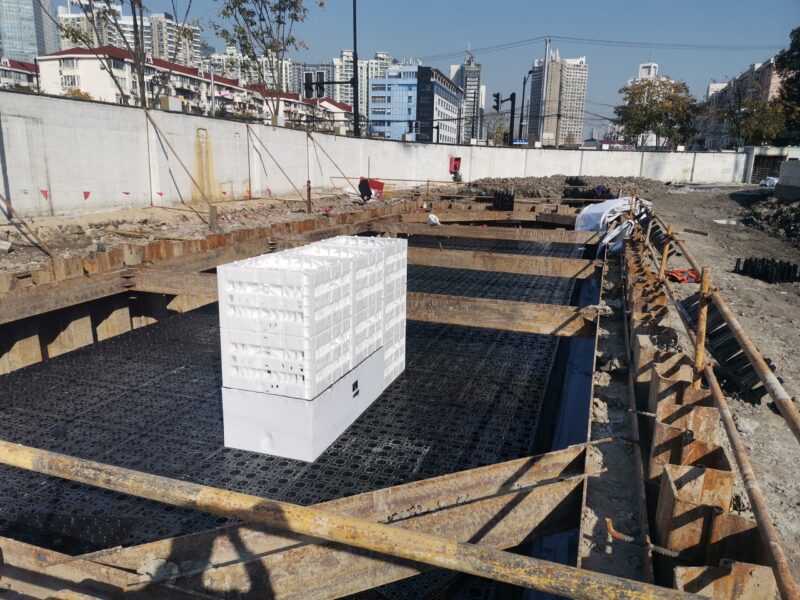
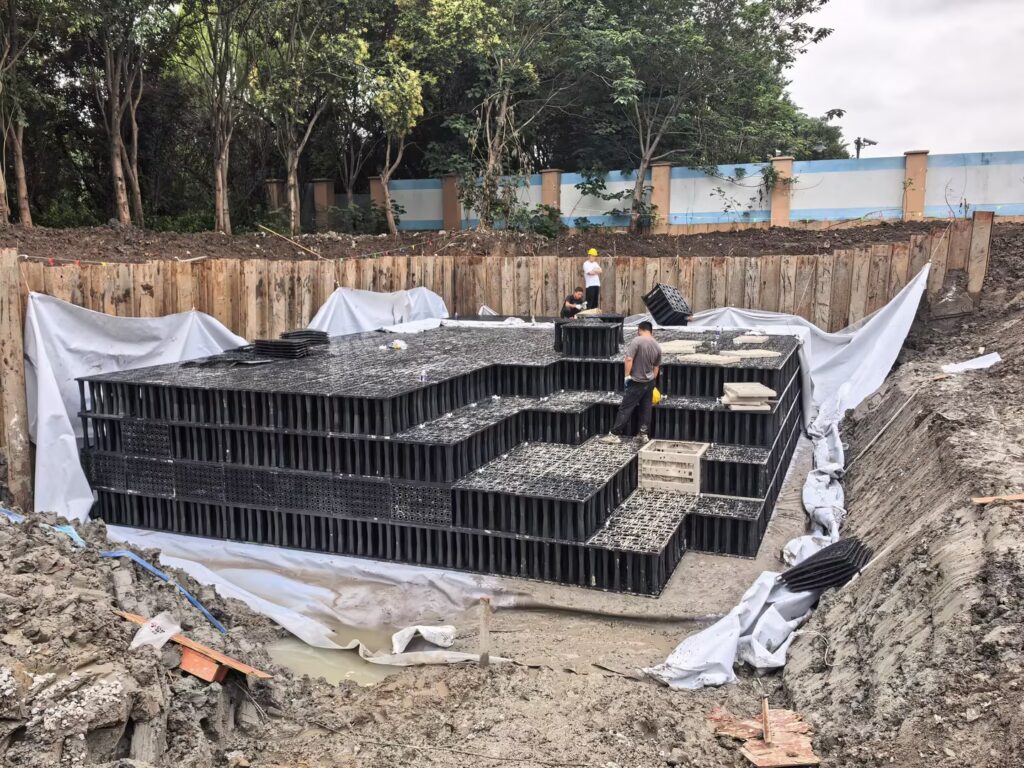
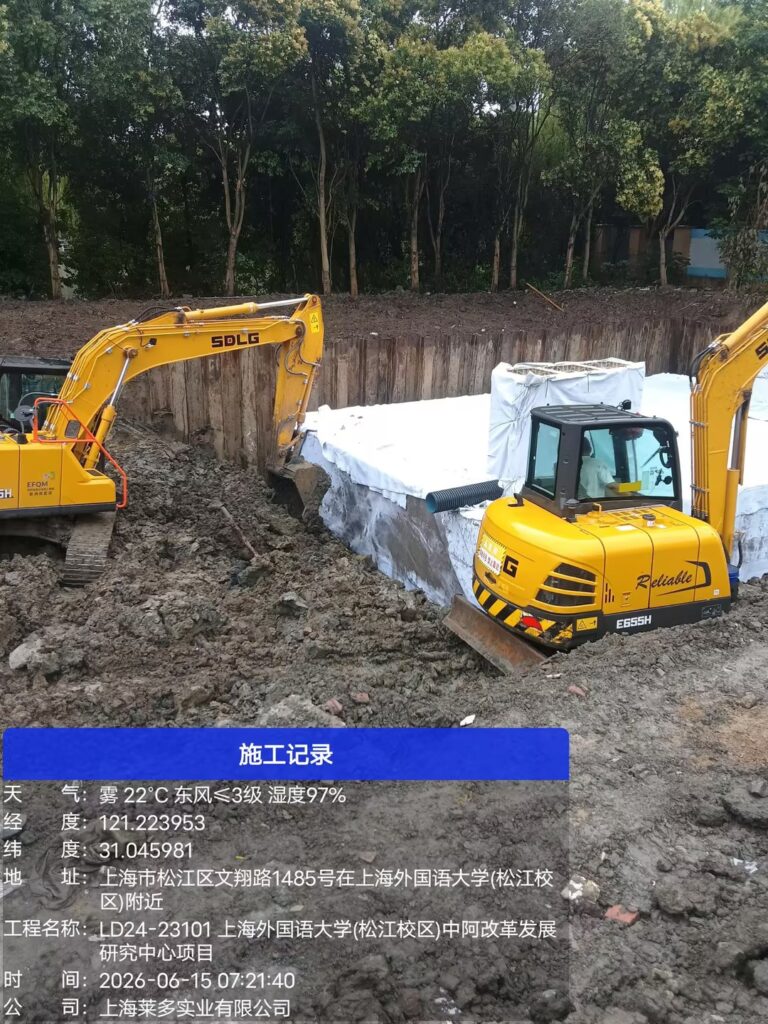
The biggest advantage is speed. Modules are standard components that snap together on site. No heavy cranes needed. A 2,000-cubic-meter tank that would take two months with concrete can be assembled in three to four days with PP modules. Excavation volume is also smaller, allowing same-day excavation and backfill. For tight schedules, this is a game-changer.
Load-bearing capacity exceeds expectations. Quality PP modules can withstand over 60 tons per square meter, making them suitable for parking lots, fire truck access roads, and green spaces. The modular structure also adapts well to uneven settlement — something concrete and FRP struggle with.
Better water quality maintenance. The smooth PP surface resists sediment buildup and algae growth. Combined with proper pre-treatment and first-flush diversion, stored water stays fresh longer. With 95% void ratio, storage efficiency is excellent — more water stored per cubic meter of excavation.
Reusable and recyclable. This is something neither concrete nor FRP can offer. If a project is temporary or needs future modification, PP modules can be disassembled and relocated. The material itself is 100% recyclable, aligning with green building principles.
Of course, PP modules aren’t perfect. Proper backfill compaction is critical — poor workmanship can lead to deformation. Also, product quality varies widely in the market, so always check test reports and reference projects before purchasing.
My Recommendation
If your project has tight deadlines, limited space, or potential future changes, or if you want to bury the tank under green space or parking lots without occupying surface area, PP modules offer the most flexibility.
If your project has strict fire resistance requirements or the tank must be installed indoors in a basement, concrete remains a reliable option.
As for FRP tanks, they work well for small-capacity, single-tank applications, but I’d recommend careful evaluation for larger projects.
At the end of the day, choosing the right rainwater storage tank depends on your specific needs. I hope this rainwater tank comparison helps you make a more informed decision.