
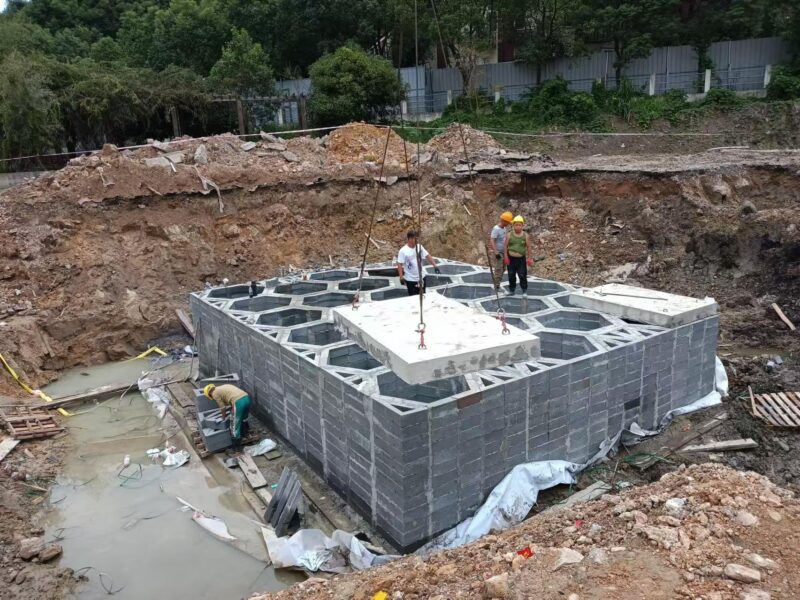
Commercial Rainwater Reuse: 320 m³ Silica Honeycomb Tank Built in 7 Days — with a Driveable Top
When you design rainwater reuse for a commercial complex, two things worry you most. Underground space is expensive, and a storage tank eats up a lot of it. And once the tank is buried, you want to put parking and fire lanes on top — but conventional PP modular tanks and cast-concrete tanks either leave you unsure about load capacity, or turn later desilting into a game of blind guessing. The Hangzhengchuchu (2024) No. 36 plot commercial development project in Hangzhou — a commercial, office and hotel site — needs reclaimed water for landscaping, green-roof irrigation and underground garage washing. We went with a hexagonal silica honeycomb tank: 320 m³, from first survey line to commissioning in 7 days. After the design backfill and road structure were restored, the top carries normal commercial vehicle traffic — underground storage and above-ground parking stacked on the same footprint.

1. Why a Commercial Project Chose Silica Honeycomb Instead of Standard PP Modules
First, what this tank actually is. It is not a “box for water.” It is built from toothed, interlocking silica pervious well blocks assembled into regular hexagonal module wells; the wells sit side by side to form a honeycomb load-bearing skeleton, wrapped as a whole in geomembrane, and capped with precast reinforced-concrete slabs. Each well has an inscribed circle of 1.20 m and a circumscribed circle of 1.44 m; the blocks are 762 × 120 × 150–200 mm, bonded with cement mortar in staggered courses.
The honeycomb geometry does the structural work: the hexagonal skeleton spreads vertical and lateral loads in six directions across the whole assembly instead of letting any single cell carry them alone, and staggered joints mean no continuous crack line runs through the wall. Local overloads stay local — they do not chain through the structure.
For a commercial owner, two things matter most:
- The space above stays usable. Once the honeycomb is loaded as a whole and the designed backfill and pavement are restored, the top can carry parking and drive lanes. The underground is not dead space.
- The water gets primary treatment as soon as it enters. The silica blocks themselves filter and retain solids; per the product data sheet, solid particle removal is ≥85%. Unlike a PP module tank that is essentially an empty cavity, the water does not turn turbid the moment it is stored.
Side by side with the two mainstream alternatives, the difference is clearer:
| Hexagonal silica honeycomb tank | PP modular tank | Cast-concrete tank | |
| Use of the space above | Integral skeleton + precast slab; restores driving/parking | Relies on single-block strength; stiffness uneven across the assembly; heavy loads feel risky | Structurally reliable, but slab design, construction time and cost are high |
| Purification | Blocks filter by themselves; primary treatment at the inlet | Empty cavity; little to no purification; water turns turbid in storage | None |
| Construction time | Factory-made blocks, assembled on site; main works ≈ 7 days | Fast assembly, but membrane and whole-system acceptance still take time | Formwork + pouring + 28-day curing at minimum |
| Later inspection | Reserved inspection wells and sludge channel; level, turbidity and sludge are visible and removable | Cannot be entered; inspection relies on probes and guesswork | Manholes allow entry, but desilting old tanks is still hard |
| Best fit | Commercial/office/hotel projects with expensive underground space that must be used on top | Low-requirement buried storage | Projects needing durability and large volume with no schedule pressure |
This is not a one-off idea of ours. The Longtan West Lake park project in Beijing built a lake-bottom regulation tank with an effective storage volume of 62,000 m³ using exactly this silica honeycomb storage-and-purification system — combined storage and purification, effluent meeting Class IV surface water quality, the first lake-bottom regulation tank in Beijing, in service since 2021. The “storage plus purification in one structure” approach has been proven at scale long before this commercial project.
2. The Full Chain: Debris Basket + First-Flush Diversion + Honeycomb Tank + Integrated Unit + Clean-Water 
Tank

The reuse chain for this project:
- Roof and site runoff is collected and first passes a debris basket / settling device, which catches leaves, plastic bags, sand and coarse suspended solids;
- It then goes through a first-flush diversion filter. The diverted initial volume is set to the local rainfall pattern and the pollution load of the catchment, so the most polluted first runoff is sent away and only the relatively clean mid-to-late runoff enters the main tank;
- The pretreated water enters the 320 m³ hexagonal silica honeycomb tank, where it settles, is retained and receives primary filtration inside the honeycomb wells;
- Water is lifted into a ground-mounted integrated unit for deep filtration + disinfection, cutting fine suspended solids, colloids and microorganisms further;
- Effluent enters the clean-water tank and is delivered by a constant-pressure / level-linked system to landscape irrigation, pond make-up, garage washing and other points of use;
- Under heavy rain, when both the honeycomb tank and the clean-water tank reach high level, surplus water overflows by design — the system never holds water hostage.
Commercial water use has clear peaks and valleys: daytime irrigation and washing are concentrated, while nighttime pond make-up runs at small flow. We treat the honeycomb tank as “storage + primary treatment,” the integrated unit as “polishing,” and the clean-water tank as “constant-pressure buffer.” Three stages, each inspectable on its own — when one stage has a problem, you fix that stage, not the whole system.
The first-flush step is not optional: first-flush runoff carries the heaviest pollution, and letting it straight into the tank raises the load on every downstream stage. The diverted volume is set to the local rainfall characteristics, not to a fixed value, and rechecked against real pollution during operation.
3. The 7-Day Schedule: What We Did Each Day and What We Checked
Our standard sequence for a silica honeycomb tank is: survey and setting out → excavation → ground treatment → base slab → lower geotextile/geomembrane → silica well block assembly (with inlet, outlet and sludge channels formed at the same time) → geomembrane wrap around the sides and top → precast RC roof slabs → cabling → backfill → M&E → commissioning. For this 320 m³ tank under a commercial drive lane, the actual rhythm and the control points were:
| Day | Work | Key control points |
| Day 1 | Setting out, excavation, dewatering | Working space 1 m wider than the slab on each side; continuous dewatering where the water table is high; never lay blocks in standing water; ground treated to 120 kPa bearing capacity |
| Day 2 | Concrete base slab | Waterproofing geomembrane welded with ≥300 mm extension beyond the slab edge; no blockwork before slab acceptance |
| Days 3–4 | Silica well block assembly | Blocks soaked; M7.5 cement mortar; staggered courses from the bottom up; inlet, outlet and sludge channels formed at the same time, with waterproofing at wall penetrations; set the alignment with locating wells first, then radiate outward so the closing joints are not forced |
| Day 5 | Geomembrane wrap + precast roof | Sides and top wrapped; lap welds ≥100 mm, membrane tight against the walls; precast slabs installed and joint sealing finished before backfill preparation |
| Day 6 | Backfill | Symmetrical, layered backfill; compaction ≥95% around the tank; membrane pressed against the walls; roof backfill only after the perimeter is done; pavement/parking restored above the slabs to the design allowable loading |
| Day 7 | M&E and commissioning | Lift pump, integrated unit, dosing/disinfection, clean-water tank controls, level and pressure interlocks wired; no-load and water-running tests; backwash cycle, constant-pressure curve and disinfection parameters locked |
Seven days is achievable because the honeycomb blocks are factory-made and assembled on site — no large cast-in-place concrete. But “7 days” covers the process core and commissioning only; it excludes earlier utility rerouting and the final landscape/pavement surface.
Three things commonly go wrong, and we watch them specifically: blockwork cannot tolerate wet working conditions, so dewatering and covering must be in place before the rainy season; the wrong backfill order can squeeze or puncture the geomembrane, so backfill must be symmetrical, layered and fine-material-first; and poorly finished slab joints are miserable to trace later when a leak appears.

4. Driving on Top: The Most Practical Feature for a Commercial Site
Under a commercial building the underground is usually garage, and above ground the owner wants as much pavement and parking as possible. The silica honeycomb tank uses a hexagonal integral skeleton plus precast slabs, and loads are spread through the honeycomb. But “driveable” never means running vehicles on the bare top; it means executing to the design conditions:
- Ground bearing capacity treated to 120 kPa, with soft soil replaced or compacted;
- Geomembrane fully wrapping the walls, symmetrical backfill compacted to ≥95%, so local settlement cannot pull the structure out of shape;
- Precast slabs reinforced and thickened for lane/parking loads, with the municipal/landscape pavement structure built above;
- Heavy-load zones are load-verified against the design before handover — we never pass by experience alone.
This lets a commercial project stack landscaping, fire lanes, visitor parking and rainwater storage in the same underground footprint, without occupying any extra ground area.
5. Operation and Maintenance: Easier Than a “Buried and Forgotten” Tank
The honeycomb tank is not maintenance-free, but it is far easier to inspect than a conventional blind-zone tank:
- The debris basket is lifted and cleaned on a schedule; the diversion device’s first-flush volume is rechecked against rainfall pollution;
- Through the reserved inspection wells you can read water level, turbidity and sludge condition, and discharge sludge through the sludge channel when needed;
- The integrated unit backwashes by differential pressure or by time; backwash water returns to pre-treatment or is routed to a designated collection point;
- The clean-water tank, disinfectant and constant-pressure pump are interlocked through the control cabinet; the property engineering team simply reads level, pressure and effluent turbidity.
Commercial owners fear one thing above all: a rainwater system that is installed but never used. When pre-treatment, tank primary treatment, integrated polishing and constant-pressure supply are separated, and operating data is transparent, the property team is willing to keep the system running long term.
6. Lessons We Would Apply to the Next Commercial Block
If a future commercial, office or hotel project considers silica honeycomb, I would confirm four things first:
- Is the catchment mainly roof or mainly pavement? — it decides the sizing of the debris basket and the diversion device;
- Is reuse only for irrigation, or also landscape, washing, cooling make-up and flushing? — it decides the integrated unit’s filtration precision and the clean-water tank volume;
- Does the top carry vehicles, and which vehicles? — it decides the ground treatment, honeycomb layout, precast slabs and backfill scheme;
- Does the construction window allow dry work? — silica blockwork hates standing water; dewatering and covering are mandatory in the rainy season.
320 m³ is not large for a commercial project. But the value of a honeycomb structure plus a ground-mounted integrated unit is that the underground space is stackable, the top can be restored to carry traffic, effluent is managed to graded non-potable standards — and the tank does not end up like a PP module tank: invisible and uncleansable.
Source: https://www.ledorain.com/