
Hotel Rainwater Reuse Case Study: 30 m³/h, 83 m Head, 600 m Supply to a Rooftop Green Roof
When we took on the Huzhou Yuanfan Hotel project this year, I hesitated at first. Not because we had never built this kind of system, but because three numbers had to line up at once: a combined treatment and supply flow of 30 m³/h, a supply head of 83 metres, and a farthest delivery distance of 600 metres. The source was not municipal water — it was a buried PP modular rainwater tank. And the system had to serve two very different loads at the same time: irrigation for the green roof on the fourth floor, and landscape water at ground level.
A hotel is not a factory. It waters greenery during the day and tops up the pond at night, so demand peaks and valleys are unpredictable. If the pressure wobbles, the far-end sprinklers on the roof go dry — and complaints arrive faster than leaks do.
This article covers how we scoped the scheme on site, how we tuned the pumps, and the small traps we stepped into, for colleagues working on hotel rainwater reuse and long-distance constant-pressure supply.
1. The Source: Buried PP Modular Rainwater Storage — Energy-Efficient, but Variable in Quality
Rainwater is collected into a buried PP modular storage tank. Roof runoff first passes through a debris interceptor and first-flush diversion, then settles and stores in the module tank. PP modules have high void ratios, install fast, and are well suited to being buried under a hotel’s parking area and green spaces. But rainwater is “weather-dependent water”: turbidity is low on fine days, and after the initial flush of a storm, suspended solids pick up — leaves, dust and roof particles all find their way in.
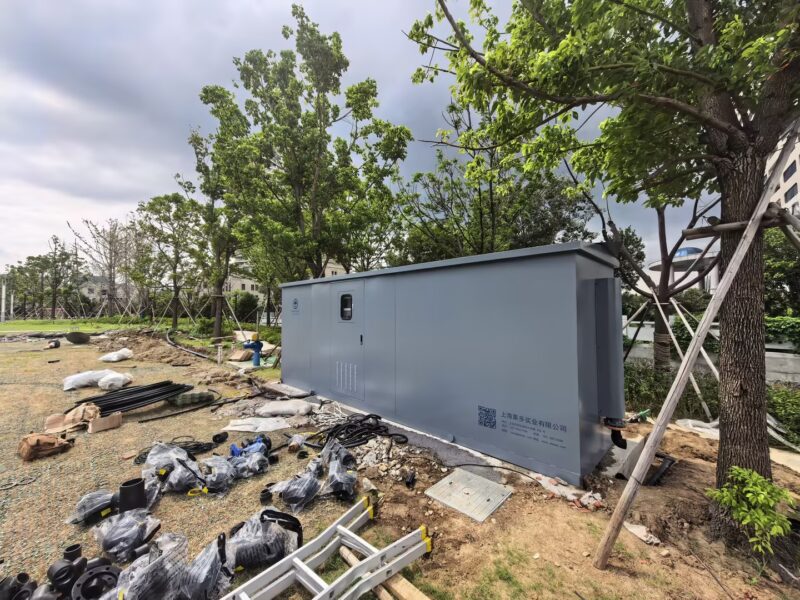
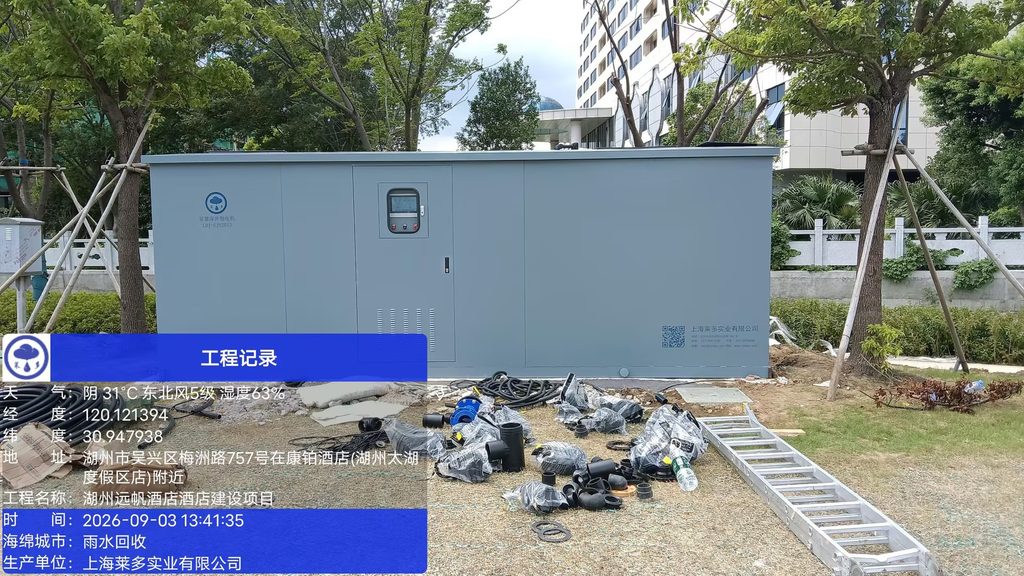
We set one principle early: the PP modules only store water; we would not pile all the fine filtration and disinfection onto the buried tank itself. Buried treatment with a submersible pump and underground filters means humidity, maintenance access and variable-frequency control headaches later — and a hotel will never let you dig the tank up for repairs. So the main treatment was moved above ground to a plant room, where a smart deep-well physicochemical unit (an integrated rainwater purification system) handles lift, physicochemical fine filtration, disinfection and constant-pressure supply in one pass.
2. Why a Smart Deep-Well Physicochemical Unit Instead of a Submersible Pump with Buried Filters
“Smart deep-well physicochemical unit” sounds like a mouthful. Broken down, it does a few concrete jobs:
- Deep-well / siphon intake: a self-priming lift from the low water level of the buried PP tank, so nothing depends on a submersible pump soaking in the tank long-term;
- Physicochemical fine filtration: flow guidance, settling, aerobic biological reaction, fine filtration and UV / physicochemical disinfection in one unit. Filtration precision is adjustable across the 5–100 µm range (per the selection data sheet); for this project we chose the finer end of the range to meet reuse quality;
- Smart constant pressure: PLC plus VFD, adjusting pump speed automatically from the clean-water tank level and the end-of-line pressure;
- Above-ground and serviceable: compared with a buried all-in-one unit, the electricals and controls stay dry and faults are located much faster.
In our standard product range, a single unit delivers 10–50 m³/h at a working pressure of 0.1–1 MPa, with backwash water consumption below 1%. The unit body is roughly 3 m × 1.5 m × 2 m in 316 stainless steel. For Yuanfan we selected around 30 m³/h — with margin, but without oversizing.
A site lesson: in hotel rainwater reuse, do not mix up “treatment capacity” and “supply capacity” when reporting. Treatment capacity follows the raw water quality and the reuse peaks; supply capacity follows the worst-case end pressure plus pipe losses. We checked both against the same 30 m³/h peak, but calculated the head entirely on the supply side.
3. 83 m Head Is Not a Guess: A 600 m Pipe Run Needs Its Own Calculation
Many people size a long-distance supply pump by building height alone. At Yuanfan, the fourth-floor green roof sits only about a dozen metres above the plant room, yet the client required 83 m of total head. The difference comes from three sources:
- Friction loss along 600 m of pipe: diameter, material and velocity change the numbers a lot. We back-calculated the pipe diameter from the design flow and kept the main-line velocity in the economical range, instead of undersizing the pipe to save on material;
- Local losses through the rooftop sprinklers and branch lines: sprinklers, valves and filters add up quickly;
- Working pressure reserve at the worst point: the roof-end system needs enough residual pressure for the sprinklers and drip irrigation to actually work — “water comes out” is not the standard.
During commissioning, we first set the VFD curve from the calculated values, then installed temporary pressure gauges at the farthest 600 m point and at the fourth-floor branch ends. The first two rounds surfaced a small issue: when the VFD slowed down during off-peak hours, the farthest sprinkler group on the roof ran low on pressure. After re-tuning the pump start threshold, the standby pressure setting and the PID response, the system held steady at 30 m³/h in peak hours and with partial branches open in off-peak hours. You can only find this kind of thing on site — selection software alone would have said “theoretically fine.”
4. From the Buried PP Tank to the Plant Room: How Lift, Filtration, Disinfection and Constant Pressure Work Together
The final scheme at Yuanfan:
Buried PP modular rainwater tank → lift into the smart deep-well physicochemical unit → flow guidance / settling / aeration → physicochemical fine filtration (set to the reuse target) → UV disinfection → clean-water buffer / constant-pressure VFD → two branches: one to the fourth-floor green roof, one to the ground-floor landscape water.
The control system was layered to avoid being “automatic but blindly automatic”:
- Lifting stops when the PP tank level is low, preventing the tank from being pumped dry;
- Lift and filtration are linked: backwash triggers automatically by differential pressure or by time, and backwash water consumption stays below 1%, so reuse water is not wasted;
- Constant-pressure supply on the clean-water side: pump speed follows the end-pressure feedback from the VFD, instead of running at a fixed frequency;
- A PLC touchscreen shows level, flow, pressure and water-quality trends, viewable from a PC or phone — the hotel engineering team can see which pump is running and when backwash happened without going into the plant room.
One detail: hotel landscape ponds turn green fastest when disinfection is intermittent. We linked UV disinfection to the constant-pressure supply — as long as water is being supplied, it passes through disinfection. If the client later wants residual chlorine in the landscape water, dosing can be added, but physical disinfection is the simpler choice for irrigation reuse.
5. Rooftop Irrigation and Ground-Level Landscape Water: Different Habits, One System
Fourth-floor green-roof irrigation is “batch use”: two rounds a day, morning and evening, with many sprinklers open at once and a high instantaneous flow. Ground-level landscape water is “top-up use”: it refills a little when the level drops, supplied by the same integrated purification system, and it needs stable turbidity and appearance — no cloudy discharge.
So the supply side cannot be one big fixed pump. We sized the system against the total 30 m³/h peak and let the constant-pressure system adjust speed with total demand: pressure is protected when the rooftop branches open wide, and the VFD drops the frequency to save power when the landscape top-up runs alone or off-peak. After a week of trial operation, the hotel’s engineering team reported that the farthest sprinkler pressure matched the near ones, and the landscape pond showed no visible water-quality swings. Only then did we lock the parameters.
6. Four Questions I Would Ask the Owner Before the Next Hotel Project
- Beyond the PP modules, is the first-flush diversion and debris interceptor on the source side done properly? The dirtier the source water, the higher the filtration and backwash frequency;
- Is the green roof irrigated by sprinklers, drip lines or a hose? The required working pressure differs, and the head margin must be recalculated;
- For a 600-metre-class supply, fix the pipe diameter and material early — changing pipe later costs more than changing the pump;
- If the landscape water is on public display and children may come into contact with it, deliver to the stricter non-potable / landscape make-up standard, not just the “irrigation” standard.
7. What This Project Taught Us
Looking back, the key was not “achieving 83 m of head.” It was splitting the system into three manageable stages: the buried PP tank only stores water and does primary settling; the smart deep-well physicochemical unit handles lift, fine filtration and disinfection; the constant-pressure system handles the end of the line. When one stage has a problem, you fix that stage — no whole-system rework.
Hotel rainwater reuse will only become more common: green roofs, landscape water, car washing and toilet flushing can all be served — each through its own pipe and at the quality it needs. If the run is longer than 200–300 metres and the water has to reach a rooftop, do not size the pump by building height alone. Put pipe losses, VFD response, backwash water and future maintenance access into the proposal from day one. Saving a little on equipment is easy; a hotel calling every day because the water has stopped is the expensive kind of trouble.