
Industry perspective · Modular stormwater storage
Why Do Rainwater Storage Module Basins Collapse? A 15-Year Stormwater Veteran Tells the Truth
Industry perspective · Modular stormwater storage
 |
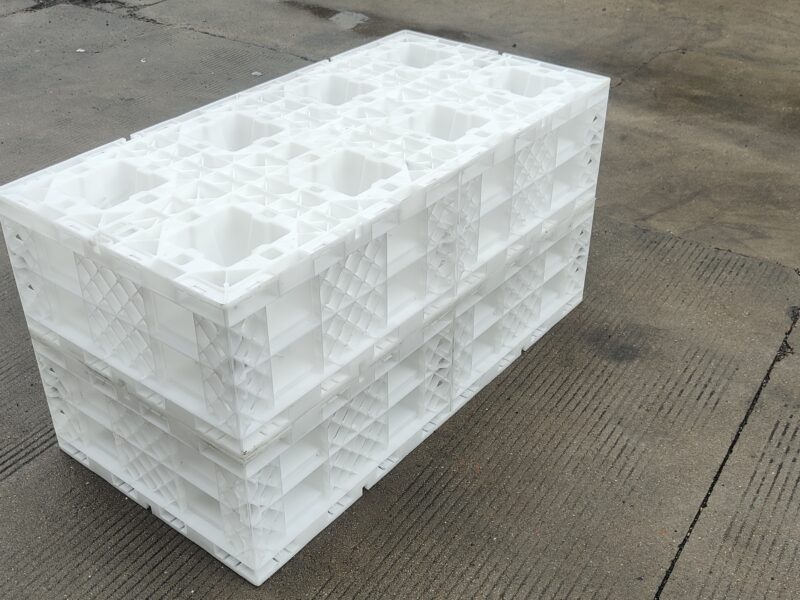
| Low-profile columnar module (Lingze) |
01 The Bottom LineAfter six months, the landscaped area above a new rainwater storage basin sinks. A year later, the pavement edge along the parking lot cracks. You excavate — and the polypropylene (PP) geocellular modules underneath are buckled and leaning. The owner’s first reaction is always the same: “The plastic modules are unreliable.”
Let me be fair: polypropylene itself is not the problem. Basin failures are almost never caused by a single factor. They are the result of four gaps failing together — structural selection, material quality, test data, and construction discipline. This article is not aimed at any competitor. It is a field summary from more than fifteen years of sponge city (stormwater management) projects, written so our industry stops burying landfill-quality products in the name of environmental protection.
To keep a basin from collapsing, buyers and specifiers only need to control four things: is the structure right, is the material honest, is the test data real, and is the installation done properly.
02 Why Basins Fail
Taller columnar modules save freight — and lose lateral stability
Columnar modules dominate the market for one reason: the taller each unit is, the cheaper the freight. So products keep getting taller — 500 mm, 600 mm, even 900 mm — while weight drops to 30–40 kg per cubic metre.
A columnar module carries lateral load mainly through two support webs. As the internal void grows, lateral earth pressure makes the unit bulge and tilt. Many basin collapses are not the top being crushed — the side fails first and the whole tank settles at an angle. You will never see this on a drawing; you only understand it the day you open the excavation. If lateral load is tested only on the two support webs, the report can claim 100 kN while the large open cavity between them actually carries far less — which is why basins with “≥450 kN/m²” front-face reports still collapse.
Field rule: for heavy-load duty, cap the unit height of columnar modules. Keep single-unit height at 300 mm or less, with full support webs, so the resulting void stays small and lateral capacity matches real conditions. Always test lateral load at the most unfavourable point — never rely on front-face data alone.
A vertical bearing report is not a structural safety certificate
Many tender documents ask for nothing but “bearing capacity ≥ 450 kN/m²” and stop there. Suppliers happily send a single front-face compression report and never mention lateral data or creep.
Polypropylene is a viscoelastic material: it creeps under sustained load. Passing a short-term compression test does not mean the module will hold for fifty years underground. In mature markets, long-term creep testing (e.g., ASTM D2990, ISO 899 series) is standard for such products. In many projects we still see a single instantaneous compression photo used as the basis for acceptance. In plain words, that is a green light for inferior products.
At minimum, a buyer should obtain four data sets: vertical bearing capacity, lateral bearing capacity, long-term creep, and material stability. If a supplier cannot provide them, exclude them.
Recycled resin used badly shortens both weight and service life
PP modules can use recycled resin — it is how it is used that matters. Ultra-cheap recycled material is full of impurities and ash, with poor oxidation resistance. Short-term strength looks fine; a few years underground, it embrittles, deforms, and loses its clips. From what we see in the market, a large share of low-priced products are made with this kind of cheap recycled resin — and it shows in the price.
Do not accept “100% virgin material” as a spoken promise. Check three things: ash content (per GB/T 9345.1 / ISO 3451-1), oxidation induction time (per GB/T 19466.6 / ISO 11357-6), which reflects antioxidant service life, and resin documentation. Then use the most intuitive metric of all — weight per cubic metre. In the same structure, too light means too little material. Industry rule of thumb: at least 40 kg/m³ for ordinary duty; at least 60 kg/m³ for heavy-load duty.
Backfill that ignores the structure defeats even the best modules
A modular basin is not simply burying a plastic box. Subgrade bearing capacity, bedding levelness, backfill type, compaction lifts, and whether machinery ever runs directly on the modules — every link affects final safety.
The worst things I have seen on site: laying modules in a flooded pit, backfilling with demolition rubble, placing 500–600 mm lifts in one pass, and running rollers directly over the geomembrane. No product survives that.
Remember one sentence: module, geotextile, geomembrane, granular bedding and compacted backfill form one structural system. It is not “just fill it with soil.”
 |
| Rainwater Storage Module |
03 Select by Service Scenario, Not by Unit Price
A simple decision logic for buyers and designers: first ask what loads the ground will carry, then work backwards to the product. Never work backwards from unit price.
•Pure landscaping, pedestrian walkways, no heavy vehicles: standard light-duty modules are acceptable, provided the use limits are met;
•Residential driveways and parking areas: use medium-to-heavy structures; lateral and creep data must be verified;
•Fire lanes, municipal roads, frequent heavy vehicles: run an individual structural calculation; add a reinforced concrete slab where required — do not rely on a brochure’s “high bearing capacity”;
•Where personnel must enter for inspection and washing: use man-entry channel tanks or concrete tanks; do not assemble a hole too small to enter from small modules.
Under our own high safety standard, five product families have proven reliable. Note: the height limit below applies to columnar modules only; fin-plate, channel and pyramid types are not height-restricted.

Experience boundary: any module below 40 kg/m³, any columnar unit above 300 mm, or any product without lateral and creep reports should be limited to small landscaping duty with cover up to 1.5 m, stack height up to 1.5 m and total burial depth up to 3 m. Beyond that envelope, treat it as high risk. Do not gamble.
 |
| Rain-release grid module |
04 Field Checklist Against Collapse
If a project chooses PP modules, these points must be enforced:
1.Verify subgrade bearing capacity; replace soft soil; dewater where the groundwater table is high; never build in water;
2.Complete the three-layer wrap — geotextile, geomembrane, geotextile; weld membrane laps properly; use flanged fittings for pipe penetrations, never tape;
3.Assemble modules strictly in the manufacturer’s marked load direction; engage all clips; re-check the horizontal level of the whole basin;
4.Backfill with medium/coarse sand or graded crushed stone — never construction waste or in-situ soil; place lifts of 200–300 mm with proper compaction; no machinery directly on the modules;
5.Backfill symmetrically — filling one side while the other side is empty pushes the basin sideways;
6.Re-calculate vehicle areas for dynamic load plus cover load distribution; use a reinforced concrete slab over fire lanes where required;
7.For acceptance, check third-party reports: vertical load, lateral load, creep, ash, OIT, full-water test, hidden-works video records and uplift (buoyancy) calculation. Missing any one — do not sign.
One terminology note: for basin watertightness, China’s code GB 50141-2008 specifies a “full-water test” — a term often confused with the pipe-system “closed water test”. Writing the correct term in the contract prevents loopholes.
05 The “False Safety” Practice We Should Abandon
There is a distorted practice in the market: buy cheap lightweight PP modules, build brick walls around them, add columns, and cast a reinforced concrete slab on top — marketed as “double protection.”
Every time I see this, I ask one question: is the safety provided by the brick and concrete, or by the PP modules? If it is the brick and concrete, why not simply build a concrete tank? It can be entered, washed and inspected; the waterproofing responsibility is clear; the structural calculation follows the code; and creep no longer matters. Why pay extra for a pile of plastic boxes inside a concrete shell?
The deeper problem is mechanical. PP is flexible; brick and concrete are rigid. Buried in the same pit, they deform completely differently. Any differential settlement cracks the concrete or squeezes the modules — and when something fails, nobody knows who to blame.
We should end this practice: either specify a certified PP module system with proper backfill, or build a man-entry concrete channel tank, a precast concrete tank, or a large-channel module. Stop using “PP as the gimmick and concrete as the safety net” — it costs twice and gives you the worst-maintained result.
 |
| stormwater storage modules |
06 How to Write a Specification That Cannot Be Gamed
Stop writing one-line parameters like “PP modules, X cubic metres, bearing capacity ≥ Y.” A truly safe specification includes at least:
•Use case and loading: landscaping, driveway, or fire lane;
•Required test data: vertical bearing, lateral bearing, and long-term creep;
•Material requirements: virgin or controlled recycled resin, with OIT and ash data provided per batch;
•Construction requirements: backfill material, lift thickness, compaction degree, and symmetrical backfill sequence;
•Structural calculation for vehicle areas per local traffic loading code;
•A man-entry channel or concrete tank option wherever personnel access is needed.
An important point: modular storage is NOT a standard-free zone. Since 2020, China has issued dedicated standards — CJ/T 542-2020 for modular rainwater storage facilities, CJJ/T 311-2020 as the technical standard for such facilities, and GB/T 40224-2021 for plastic modules for rainwater infiltration, regulation and storage — alongside the general codes GB 50400-2016 (rainwater control and utilization of buildings and sub-districts) and GB/T 51345-2018 (sponge city assessment). Material tests have standard methods: OIT per GB/T 19466.6 / ISO 11357-6, ash per GB/T 9345.1 / ISO 3451-1. The real gap is not the standards — it is that too many tenders never cite them and too many acceptance procedures never enforce them. Put the standards into the tender, and the low-price suppliers are filtered out naturally.
07 Closing Thoughts
Modular storage itself is a good product: light, fast to install, recyclable, and completely reliable when specified for the right duty. But years of price competition have disordered the market — inferior recycled resin, over-tall columnar modules, and fake-safety concrete cages, each more absurd than the last.
People in this industry should not end up burying garbage. Cleaning up starts with one step: rewrite the specification parameters. Manage lateral load, creep, material and construction together. Use modules where modules belong, and concrete where concrete belongs. Do not make simple things both expensive and unsafe.
Standards referenced (verified 2026-09-28): GB/T 40224-2021 Plastic modules for rainwater infiltration, regulation and storage; CJ/T 542-2020 Modular rainwater storage facilities; CJJ/T 311-2020 Technical standard for modular rainwater storage facilities; GB 50400-2016 Rainwater control and utilization for buildings and sub-districts; GB/T 51345-2018 Sponge city construction assessment standard; GB/T 19466.6-2009 (oxidation induction time, DSC); GB/T 9345.1-2008 (ash content); GB 50141-2008 (full-water test for water and wastewater structures); ASTM D2990; ISO 899 series; ISO 11357-6; ISO 3451-1.
Tim Chen | Shanghai Leorain Industrial Co., Ltd. (Ledo)