
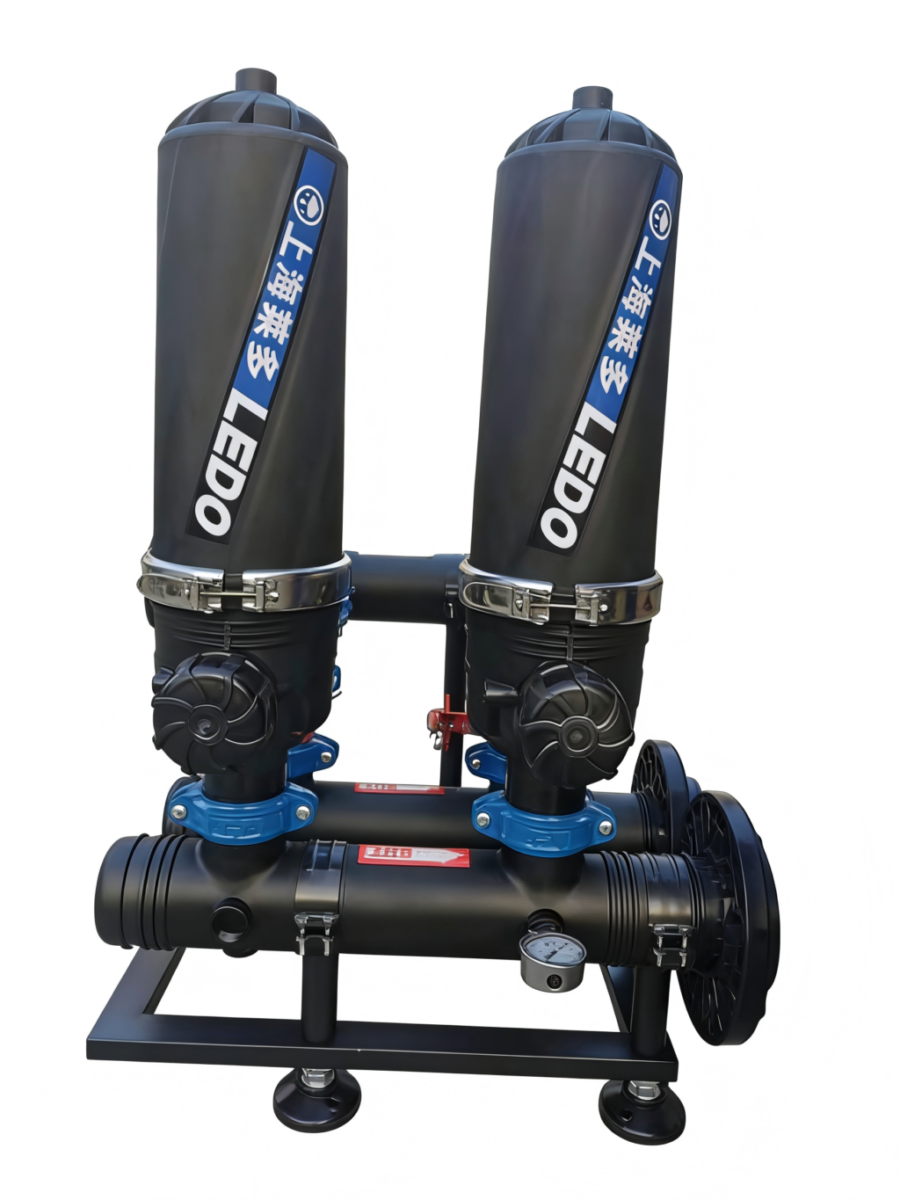
(I) Principle
The filter element of the Bin Filter consists of a stack of discs with grooves on both sides. The intersecting points formed by the edges of these grooves create micron-sized filtering compartments that trap solid particles in the water. By combining surface interception and cohesive effects, the filtration efficiency is significantly enhanced. Furthermore, the Bin Filtration system features backwashing, full-automatic continuous operation, low self-consumption of water, a compact footprint, and high operational reliability. The backwashing process for each filter unit proceeds alternately and automatically switches between filtration and backwash states, ensuring uninterrupted water output and minimal system pressure loss. This makes the Bin Filtration system technologically superior.
- To achieve the task of automatic self-cleaning, large-flow Bin Filter units are composed of multiple combined modules.
- Each filter vessel is injection-molded from high-pressure-resistant polyamide combined with glass fiber reinforced material and is secured by easy-to-open stainless steel clamps.
- The filter element holder features a complex, telescopic cylindrical structure formed via a single injection molding process. The hydraulic actuating mechanisms are enclosed within the sealed cylindrical structure, preventing clogging and failure, thereby extending the service life.
- The polypropylene bins, under the compression of the filter element stack, form a robust cylindrical filtration unit, providing reliable filtration performance to meet precise filtration requirements.
- The inlet and outlet piping for the filter unit is available in painted carbon steel, stainless steel, or pure plastic polyethylene (PE) for user selection.
(II) Operation of the Bin Filter System
The filtration system operates in two states: the Filtration State and the Backwash State.
Filtration Mode: During filtration, unfiltered water flows from the outside of the filter element through the bins. The bins are pressed tightly together under spring force and hydraulic pressure. Impurity particles are trapped at the intersecting points of the bins, and filtered clean water flows out of the unit.
Backwash Mode: When the designed pressure differential or time is reached, the system automatically enters the backwash state. The control system activates valves to change the flow direction. Backwash water pressure compresses the springs, loosening the bins. Nozzles located on the central pillar spray tangentially, causing the bins to rotate. This action rinses and expels the trapped impurities.
(III) Product Features of the Bin Filter
- System Operating Pressure: 0.2 ~ 0.8 MPa
- Backwash Pressure: 0.15 ~ 0.8 MPa
- Operating Temperature: < 60°C
- pH Range: 4 – 13
- Number of Filtration Units (A): 2 – 10
- System Backwash Method: Utilizes the filtrate from the remaining in-service units to backwash each unit individually and sequentially until all are completed.
(IV) Design and Selection of Bin Filters
1. Classification of Feed Water Quality:
A. Excellent Quality: Municipal tap water, well water from a stable aquifer.
B. Normal Quality: Recirculating cooling water, surface water after sedimentation treatment, effluent after sedimentation and complete biological treatment.
C. Poor Quality: Groundwater from poor-quality aquifers, effluent after primary sedimentation but with little or no biological treatment, surface water with significant microbial growth.
D. Very Poor Quality: Well water from heavily contaminated or iron/manganese-rich wells, flood-affected surface water without sedimentation, raw effluent without sedimentation or biological treatment.
Feed water quality significantly impacts the filtration cycle. Generally, when selecting a system, ensure the interval between backwashes is not less than 1 hour.
2. Selection of Filtration Grade (Micron Rating):
Selecting the correct filtration grade (bin disc micron rating) is crucial for ensuring the Bin Filter system functions effectively within the entire water system. Only a proper selection can meet downstream water quality requirements. The table below recommends filtration grades for common central filtration applications.
| Application of Filtration System | Recommended Filtration Grade |
|---|---|
| Rainwater, Feed Water Pretreatment | 20 µ |
| Potable Water Pretreatment, Process Water, Nozzle Protection | 50 µ |
| Recirculating Water Side-stream Filtration, Feed Water Pretreatment | 100 µ |
| Reclaimed Water Treatment, Wastewater Treatment | 200 µ |
The selection of the filtration system is based on feed water quality, the required filtered water precision, and the hourly output flow rate.
3. Selection of Backwash Mode:
3.1 If the inlet pressure is greater than (Minimum Backwash Pressure + 1.2 bar) AND the filtration flow rate is more than 5 times the backwash flow rate, the Internal Source Backwash mode can be selected, and a back pressure valve may not be required.
3.2 If the inlet pressure is greater than the Minimum Backwash Pressure AND the filtration flow rate is more than 1.5 times the backwash flow rate, the Internal Source Backwash mode can be selected, but it must include an automatic back pressure valve.
3.3 In all other cases, the External Source Backwash mode or Collective Backwash mode must be selected.
Details
| ref | WATLA |
|---|---|
| material | PP Polypropylene |
| width | 140 |
| Height | 100 |


Reviews
There are no reviews yet.