
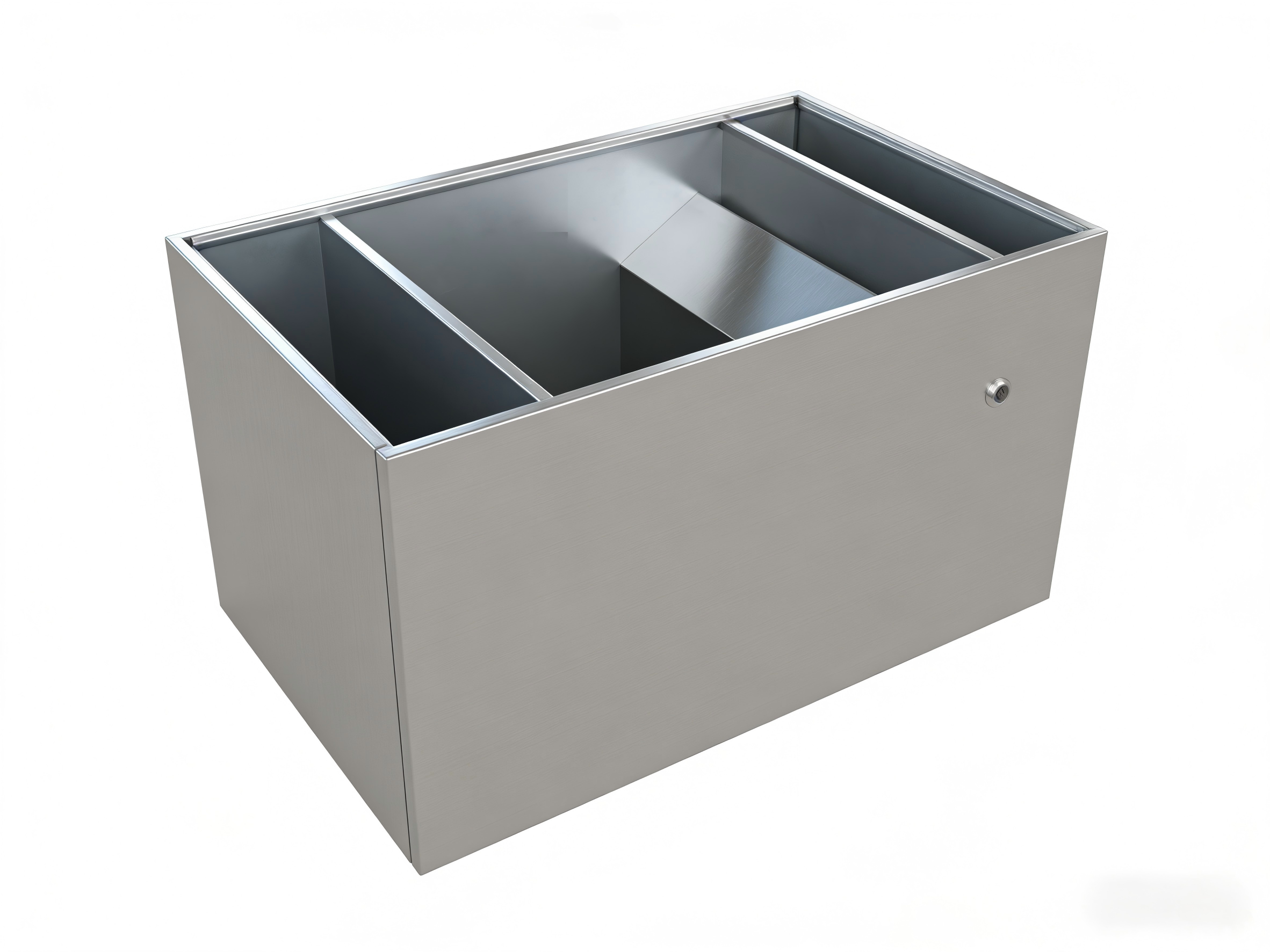
(I) Working Principle
Oily wastewater is treated using the natural flotation method, leveraging gravity and the difference in specific gravity between oil and water to separate and remove free oilandfine dispersed oil. The internal structure is divided into three compartments, enhancing oil-water separation efficiency. By applying the principles of flow diversion separation and the between turbulent and laminar flow, the wastewater velocity decreases as it passes through the separator. This is achieved by increasing the flow cross-sectional area, thereby reducing the flow velocity (≤0.005 m/s), increasing the hydraulic retention time, and ensuring a uniform flow rate across the entire cross-section. The design of the outlet zone fully considers flow uniformity and incorporates measures to prevent odor and siphonage. Practice has proven that this product can remove over 90% of with a particle size above 60µm. The content of animal and vegetable oils in the discharged effluent meets the standards specified in the “Integrated Wastewater Discharge Standard” (GB8978-1996).
(II) Product Features
- Overall: Fully enclosed structure, odor-free, easy cleaning of intercepted residues.
- Efficient Multi-Stage Separation: Utilizes aggregated buoyancy oil removal technology.
- Design: Maintenance-free, compactand reliable.
- Auxiliary Heating: Prevents solidification of polyunsaturated fats/oils .
- Integrated Design: Low turbulence coefficient for more efficient separation.
- Operation & Maintenance: Simple operation, low maintenance costs.
- Oil Recovery & Energy Saving: Features automatic oil discharge and fluid dynamics structural design.
- Integrated Solid-Liquid & Gravity Separation Zones.
- Gravity Separation Zone (Primary): Removes oils with specific gravity between 0.50-0.60.
- Coalescing Separation Zone (Core Technology): Features a secondary turbulence suppression design structure, removes oils with specific gravity between 0.25-0.35, and targets oil droplets above 30µm.
- Temperature Design: Operates above 5°C. Auxiliary heating is applied below 5°C.
- Performance: Low turbulence coefficient, favorable flow conditions.
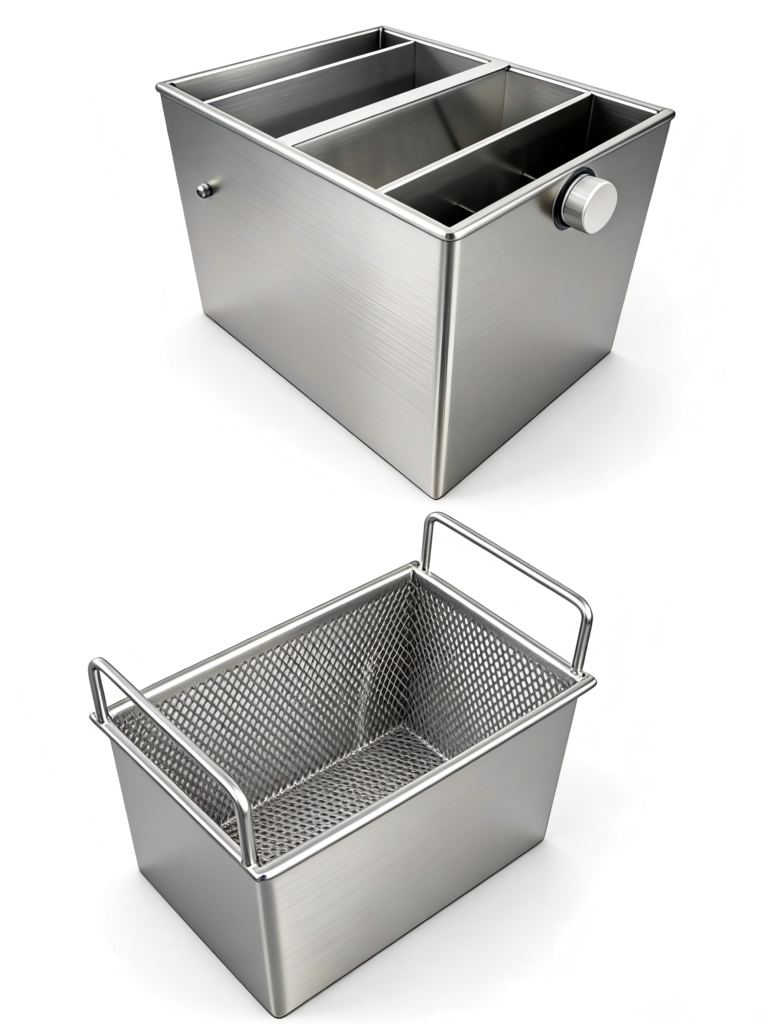
(III) Structural Configuration
Structural Principle: The oil-water separator mainly consists of an inlet, a solids collection compartment, baffles, tank body panels, a cover plate, an outlet, and an outlet screen罩. It can be broadly divided into two main functional zones: the Interception & Separation Zone and the Purification & Discharge Zone.
- Interception & Separation Zone: Primarily intercepts and removes solid such as food waste from the oily wastewater and employs gravity separation) to gradually separate oil, sludge, and water.
- Purification & Discharge Zone: Further clarifies and separates the treated water through sedimentation, which is finally filtered and discharged through the outlet screen, achieving a high level of purification for the oily wastewater.
(IV) Application Scope
Oil-water separators are widely used in large shopping malls, office buildings, schools, military facilities, various hotels, restaurants, high-end guesthouses, and commercial kitchens for grease interception and cleaning in drainage pipes. They are also ideal for oil separation in garage drainage pipes and municipal oil interception applications. Furthermore, they are also applicable for treating oily wastewater such as industrial coating wastewater.
Details
| ref | WATLA |
|---|---|
| material | PP Polypropylene |
| width | 140 |
| Height | 100 |

Reviews
There are no reviews yet.